
We calculate rates in line with the Fair Go Rates System which has capped rate increases by Victorian Councils to the forecast movement in the consumer price index and wage price index. This cap applies to the average, per property increase and not to individual rate notices.
How your rates are calculated
On 30 June 2026, we declared:
- That a general rate be applied at a uniform rate of 2.827677 per cent in each dollar of the Net Annual Value (NAV) be declared in respect of the 2026–27 financial year.
- a service charge (waste and recycling) of $740 for a 240-litre bin, $370 for a large family or medical 240-litre bin, $370 for a 120-litre bin and $370 for a shared 240-litre bin.
- a service charge (litter management) of $98 for residential properties with private bin services.
- a service charge of $80 for additional recycling bins.
- a service charge of $48 for an additional green waste bin.
How we calculate your general rates
We calculate the general rate in the dollar by dividing the total rate revenue by the Net Annual Value (NAV) of all rateable assessments (properties). We then apply this rate to all rateable assessments. For example, if total rate revenue is $40 million and our rateable assessments have a total NAV of $950 million, the rate in the dollar is 4.2105 cents in the dollar of NAV.
To calculate the rate for 2026–27, multiply the property’s NAV as shown on the rate notice by the rate in the dollar, which is 0.02827677 or 2.827677 per cent. For example, if your property has a NAV of $25,000 the rate payable would be $706.90 (rounded down) plus any applicable service charges.
Waste and recycling service charges
Glen Eira’s policy is to levy waste and recycling charges on the basis of cost recovery.
Waste and recycling charges appear on your rate notice for the use of our waste collection service. These charges pay for kerbside waste collection, hard rubbish collection, recycling, waste disposal, and the State Government Landfill Levy — which we must pay when depositing waste at landfill.
Waste and recycling charges are compulsory for residential properties, but optional for commercial properties. They don't apply to properties with no improvements (vacant land), provided Council has been notified that any demolition works have been completed and the appropriate documentation has been supplied, such as a Certificate of Final Inspection.
See Waste services and pricing for a full list of fees.
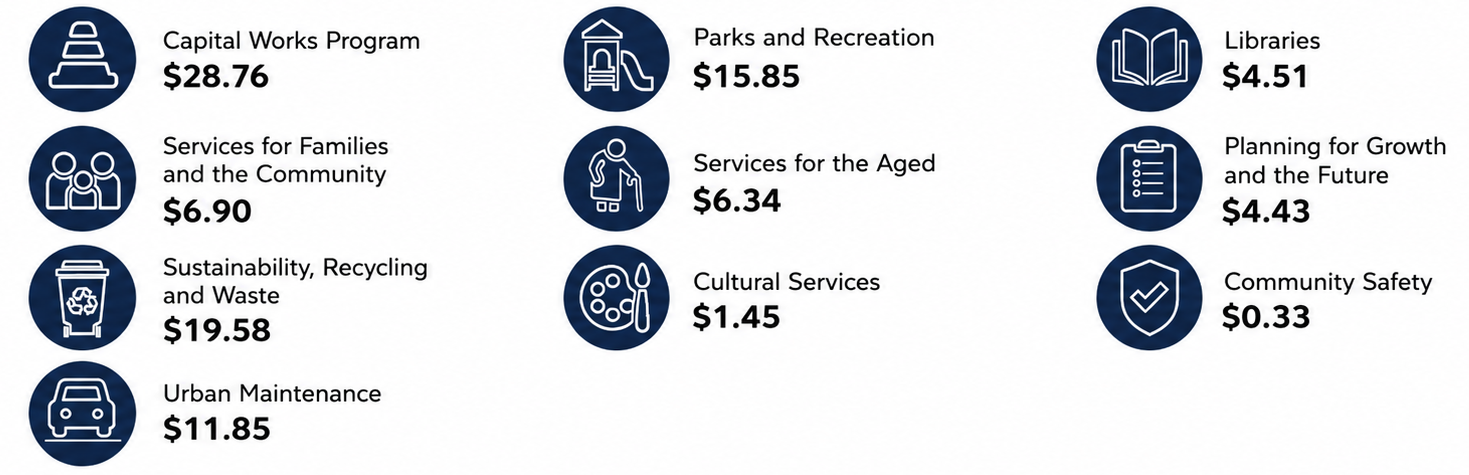
Where your $100 in rates is spent
Emergency Services and Volunteers Fund levy (ESVF)
The Victorian Government sets the ESVF levy. Everything we collect is passed onto the Victorian Government to fund fire agencies and other State Emergency authorities.
Read the Victorian Government's ESVF — frequently asked questions
Goods and services tax (GST)
Council rates and waste and recycling charges are exempt from GST, pursuant to Div. 81 of the A New Tax System (Goods and Services Tax) Act 1999.
Special rates
Councils can levy special rates on property owners to help pay for council services or activities that will benefit them. Examples include constructing footpaths, car parks or roads in a particular area, and promoting local businesses.
For more information, visit our Special rates page.
Questions and answers
The Victorian Government’s rate cap system restricts how much councils can collect in rates.
This video explains how rate capping works:
-
MAV How does rate capping work
What are the components of my annual Council rates bill?
- General rates (capped at 5.00 per cent)
- Waste and recycling charges (not subject to rate cap)
- Emergency Services and Volunteers Fund (not subject to rate cap)
What is the rate cap variation and how does it affect my property ?
Each year, the Victorian Government sets a rate cap, which limits how much councils can increase the total amount of general rates collected.
For 2026–27, the Victorian Government specified a rate cap was set at 2.75 per cent.
The cap applies to the average increase of rates and charges. Council applied to the Essential Services Commission for a higher rate cap for 2026–27, which was approved. A higher rate cap of five per cent applies for 2026–27 and Council has complied with this cap.
The rates and charges for your property may have increased or decreased by a different percentage amount for the following reasons:
- the valuation of your property relative to the valuation of other properties in the municipality
- the application of any differential rate by Council
- the inclusion of other rates and charges not covered by the higher rate cap
Has Council increased my property's market value to get more rates from me?
We don’t receive extra money if your property value increases. Some ratepayers will pay less than the five per cent cap and others will pay more.
